
How do you get tree roots out of your sewer line? Watch this one-minute video as Casey tells you how...
Showing posts with label sewer repair. Show all posts
Showing posts with label sewer repair. Show all posts
Thursday, May 08, 2014
How do you get tree roots out of your sewer line?
Thursday, April 10, 2014
What and where's your sewer cleanout - and why does it matter?
What and where is your sewer cleanout?...and why does it matter?...in this video Casey tells you...
Wednesday, April 09, 2014
Should you get a sewer inspection when you buy a house?
When you're in the market for a new home purchase get a sewer inspection before you buy - here's Casey to tell you why...
Wednesday, August 01, 2012
Do You Have a Sewer Line Clog? Know the Signs...
 Why is it that mainline sewer backups always seem to occur (1) after hours for the plumber, or (2) when you have a house full of people? Seriously. Why is that?
Usually we chalk that kind of thing up to Murphy's Law - "Anything that can go wrong, will go wrong." But truthfully, there are often signs of impending problems. Heed the signs and you just might be able to respond before the line becomes completely clogged and waste water backs up into the building.
Here are a few things to pay attention to:
1. Are Multiple Fixtures Affected?
A very obvious sign of a sewer drain clog is when more than one plumbing fixture is draining slowly or backing up at the same time. If you suspect that you have a sewer drain clog, check other fixtures in the home - particularly the tub and shower.
Toilets have the most direct path to the sewer and the biggest drain line in the house, so if there is a problem with the sewer line you shoiuld notice it when you try to flush the toilet. It's rare to have a mainline sewer stoppage when the toilets are working properly.
And then tub and shower drains sit lower than sink drains, so check them next. Do you have water backing up or failing to drain in your tub/shower? If so, it's probably time to call the plumber.
2. Out-of-the-Ordinary Occurences (with respect to plumbing fixtures).
Don't ignore burbling sounds or waste water moving upstream.
If you've got an issue with the sewer line, air may get trapped in the plumbing system. Do you get bubbles in the toilet bowl when you run the faucet in the closest sink? Do you get ominous gurgling sounds when you flush the toilet or take a shower? These are all signs that waste water isn't moving smoothly through the system.
And definitely if you have water rising one place when you're using a fixture another place, you've got issues somewhere in the sewer line. For instance, if the water draining out of the washing machine causes the toilet to overflow or backs up into the tub or shower it could mean a clog on the main sewer line. (Although if the toilets are still flushing fine while this occurs then this is likely due to a washing machine stoppage and not a mainline stoppage.)
3. Check the Drainage at the Clean-Out
If you have a mainline clean-out (and hopefully you do), you can remove the cap and physically check to see whether or not the line is draining. You should not be able to see the water coming up the clean out pipe. If water is flowing up and out of the clean out or standing in the pipe, the line is not draining.
4. And Lastly...
If your house has a septic system, always ask yourself: "How long has it been since the tank was cleaned out?"
---

The problem could be a straight forward clog or there could be roots or some other kind of break in the line that prevents the line from clearing completely. These issues don't necessarily happen all of a sudden but develop over a period of time. Watch for indications that something is not right on the drain lines.
Wednesday, September 21, 2011
Roots in a Sewer Line? There's a Solution for that..
Here at Boden Plumbing, mainline stoppages - or sewer line backups - are one of the most common service calls we get. Oftentimes it is a straightforward stoppage and the location has a sewer clean out, which makes accessing the pipe pretty simple, so we can rooter the drain and have everything running smoothly again in short order. However, sometimes it's not a simple clog: our customer has roots in their sewer line.
Clearing a clog is one thing. Cleaning the sewer line of obstructions that will cause chronic clogging is something else again.
If you have roots in your sewer line, our big heavy duty snaking equipment can get the line open and even pull out a good portion of the roots so your line will function again. But the snake can not clean the line of roots completely and what roots are left behind will regrow and cause another clog. (Just so you know.)
Really cleaning a line takes a different type of equipment. We use what we call our "scorpion cutter", which has a rotating cutting head that spins inside the pipe cutting off the root intrusions essentially flush with the surface of the pipe.
That's the mechanical solution. It's a much better solution when you have roots in the line that repeatedly dealing with clogs. But the integrity of your sewer line is still compromised. The roots will be slower to grow back, but they will grow back.
We recommend following a scorpion cleaning with a treatment of Root-X, a herbicide product that really knocks the roots back. And then every six to nine months treating the line again with Root-X to keep those roots at bay.
If your pipe is really broken badly or very large roots have compromised the line, you might want to to ahead and replace some or all of the line. That's the final or ultimate solution - and the best choice in some instances.
The good thing is that if you do have roots in your sewer line, you also have options. And better still, we can inspect the line using a camera, which makes is super easy to decide on the best option for your particular situation.
Have questions? Just give us a call. We're here to help.
---
More info from Boden Plumbing on 'Roots in Your Sewer?':
Cameras help pinpoint sewer line problems - big time
Roots in the sewer line
5 tips for maintaining clear drains
Got clogs? Clear drain lines naturally
Wednesday, August 18, 2010
Cameras help to pinpoint sewer line problems - big time

Yes we can peer into out-of-the-way places deep in the recesses of your sewer pipes!
At Boden Plumbing we use cameras to inspect and even videotape sewer lines. They're a real lifesaver - or at least a time and money saver, not to mention a true headache preventer, when it comes to pinpointing problems and coming up with the most effective repair strategies.
It used to be that if your plumbing was clogged, you would call your plumber and he (or she!) would come and snake the line. If all was right with the World, it would be a simple clog and rootering the line would clear it. If, however, the cable came back with pieces of root on it, things were not so hunky-dory.
If there are roots in sewer pipes, it means the pipe is cracked or broken somewhere along the line. A plumber can use the snake or other tools to clear away as many of the roots as possible, but once a pipe is compromised roots will continue to find their way in. Forever. Snaking out the line will be a periodic requirement.
And decisions about how best to repair or manage the damage are difficult - BECAUSE YOU CAN'T SEE WHAT THE HECK THE PROBLEM IS.
But that was then, this is now.
Our cameras function very similar to a snake. On the tip there is a small infrared camera that transmits a video feed of the interior of the pipe. We can save the feed to a video cassette or simply use the camera to inspect on the day. The camera equipment also indicates distances which means if we do see a break we'll know where along the line it occurs. No digging up the whole darned yard to repair one short length of pipe. So, yeah, these cameras are a life saver.
We like them because they take the educated guess work out of our equation. We've repaired and replaced a lot of sewer pipes and we're good at deciding how best to proceed, but we like to know we're taking the most efficient and cost-effective route to a solution. Plus, you can watch the video with us live. You see what we see. It makes our job of explaining options that much easier.
So good stuff. Keep in mind that because we can save the inspection to a tape, the camera is also a great tool for documenting the condition of sewer pipes when you're buying or selling a house.
If you have any questions, just give us a call. We're here to help.
Wednesday, February 27, 2008
Roots in the Sewer Line
 TREE ROOTS VS. SEWER LINES - it's a classic match up and one that you would expect to have a predictable outcome. (The roots always win, right?) Well, not necessarily.
Roots will most certainly take advantage of any existing break, crack, or separation in a line of sewer pipe, but they will not initiate a break. Once a crack has developed, however - due to age deterioration, shifting ground, or other damage - the roots of nearby trees and shrubs will be attracted by the warmth and moisture in the line.
The flow of warm water inside a sewer lateral causes water vapor to escape to the cold soil surrounding the pipe. Tree roots are attracted to the water vapor leaving the pipe and they follow the vapor trail to the source of the moisture, which are usually cracks or loose joints in the pipe. Once the roots reach the crack or pipe joint, they will continue to grow through the opening to reach the nutrients and moisture inside the pipe - even in winter when you might think the trees would be dormant.
Problems Caused by Roots Inside Sewers
Once inside the pipe, roots will continue to grow, and if not disturbed or impeded by standing water, they may completely fill the pipe with hair-like root masses at each point of entry. The root mass then becomes matted with grease, tissue paper, and other debris that would normally flow freely through the line. The first signs of a slow flowing drainage system are gurgling noises from toilet bowls and wet areas around floor drains. A complete blockage will almost certainly occur if nothing is done to remove the roots and partial blockage. As roots continue to grow inside the pipe, they expand and exert considerable pressure at the crack or joint where they entered the pipe. The force exerted can break the pipe and may result in total collapse of the pipe, at which point the affected section will require replacement.
Deteriorated sewer laterals leak raw sewage into the ground, which can create a health hazard. Groundwater and rain also seep into the sewer system overloading it and the wastewater treatment facility beyond their capacity. The resulting backups and overflows lead to the discharge of untreated sewage into the Bay and the creeks.
What You Can Do to Control Roots in the Sewer Lateral
Once you suspect roots in your line (inspection with a video camera can confirm this), it is possible to clear them and, with periodic maintenance, keep them clear. Here at Boden Plumbing, we clear roots from sewer lines using what we call a "scorpion cutter" that effectively scours the line of any roots and build up. We then follow that up with the application of a foaming herbicide to retard regrowth. Continue treatment every 9 to 12 months with the herbicide and that should keep the roots from growing back.
A longer term solution is to follow up the scorpion cleaning with a reline of the sewer pipe. This can be done as a spot repair if just one section of the line is compromised or along the whole length of the pipe, but it needs to be done while the pipe still retains its form. Once a section or length of pipe has collapsed, it will need to be dug up to effect a repair.
There's no need to remove a tree solely because of roots in lines. The best defense against having tree roots in lines is to make sure that your lines are in good condition and that they're not cracked. So inspect the line if you suspect a problem, and clear those roots if you find them. If you know the condition of your sewer line you can reline before the pipe collapses!
For more info, check out these resources:
:: Boden Plumbing trenchless services
:: About RootX
Friday, December 14, 2007
Sonoma County Considers Ammendment to Sewer Lateral Ordinance
In an effort to protect groundwater quality, the Sonoma County Water Agency, along with a group of county sewer districts, have proposed amendments to their respective ordinances. These changes would introduce new requirements for inspection, maintenance, and repairs of sewer laterals.
Similar requirements have been in effect in Marin County for awhile now and have helped to address a number of important issues - including safeguarding groundwater quality. We think it's a good step for Sonoma County to take - and high time.
The sewer lateral is the pipe that conveys wastewater from a home to a main sewer system pipeline. The "main" then transfers the collected wastewater to the local treatment facility. When the lateral line is damaged both precipitation and groundwater can infiltrate the line and add to the load being transported to the sewer plant for treatment, potentially overloading capacity at the plant. Wastewater in the pipe can also leach out into the surrounding ground and mix with groundwater. Breaks also give roots an opportunity to work their way into the line and create more damage to the pipe. A homeowner may not be aware of a problem until the line nearly collapses or the roots block enough of the pipe to cause a backup.
The proposed changes would require, among other things, inspection of lines before a sale or change in ownership of a property and when a building permit is pulled for an additional toilet installation.
If you'd like more information about the likely changes in store for Sonoma County, you can visit the water agency's website or contact Project Manager Kevin Booker by email or phone at 707-521-1865.
Friday, December 01, 2006
Why Dig? Go Trenchless!
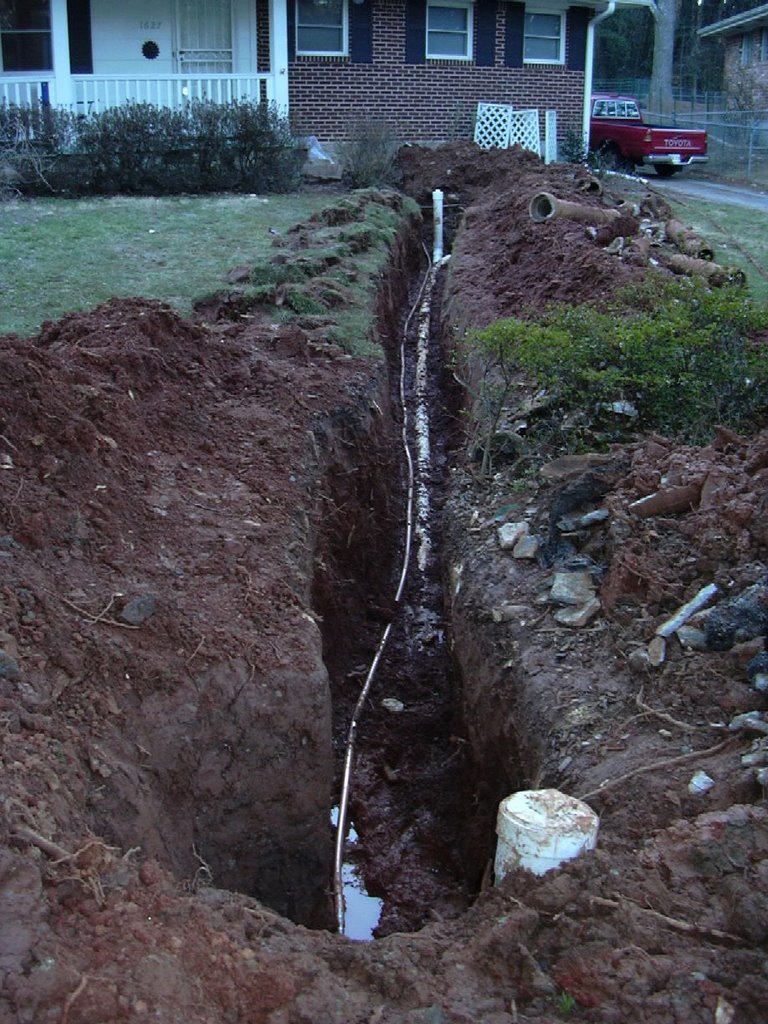 Do you have roots pulling apart your sewer line or some other damage that calls for extensive repair or replacement? Well, before you dig consider the alternatives.
At Boden Plumbing we use a drain lining system that provides a cost effective alternative to traditional dig methods of pipe replacement - and yet still offers the structural strength of new pipe. And no trenches required!
This patented system allows our technicians to replace underground pipe without disturbing any surface materials such as driveways, landscaping, porches, sidewalks, floors, electrical & gas lines or water lines (which means no locates), roadways, and parking lots.
Your existing pipe provides the form for a slick new skin that restores the integrity of the line. It's really very ingenious.
If you'd like to know more, check out the why dig? website - or email us here at Boden. We can tell you about the projects we've done and discuss with you whether or not the trenchless way is suitable for your situation. Chances are it's a real good choice!
Subscribe to:
Posts (Atom)


 Posts
Posts

